Dubai
WhatsApp Chatbots for Dubai Businesses: What Actually Works
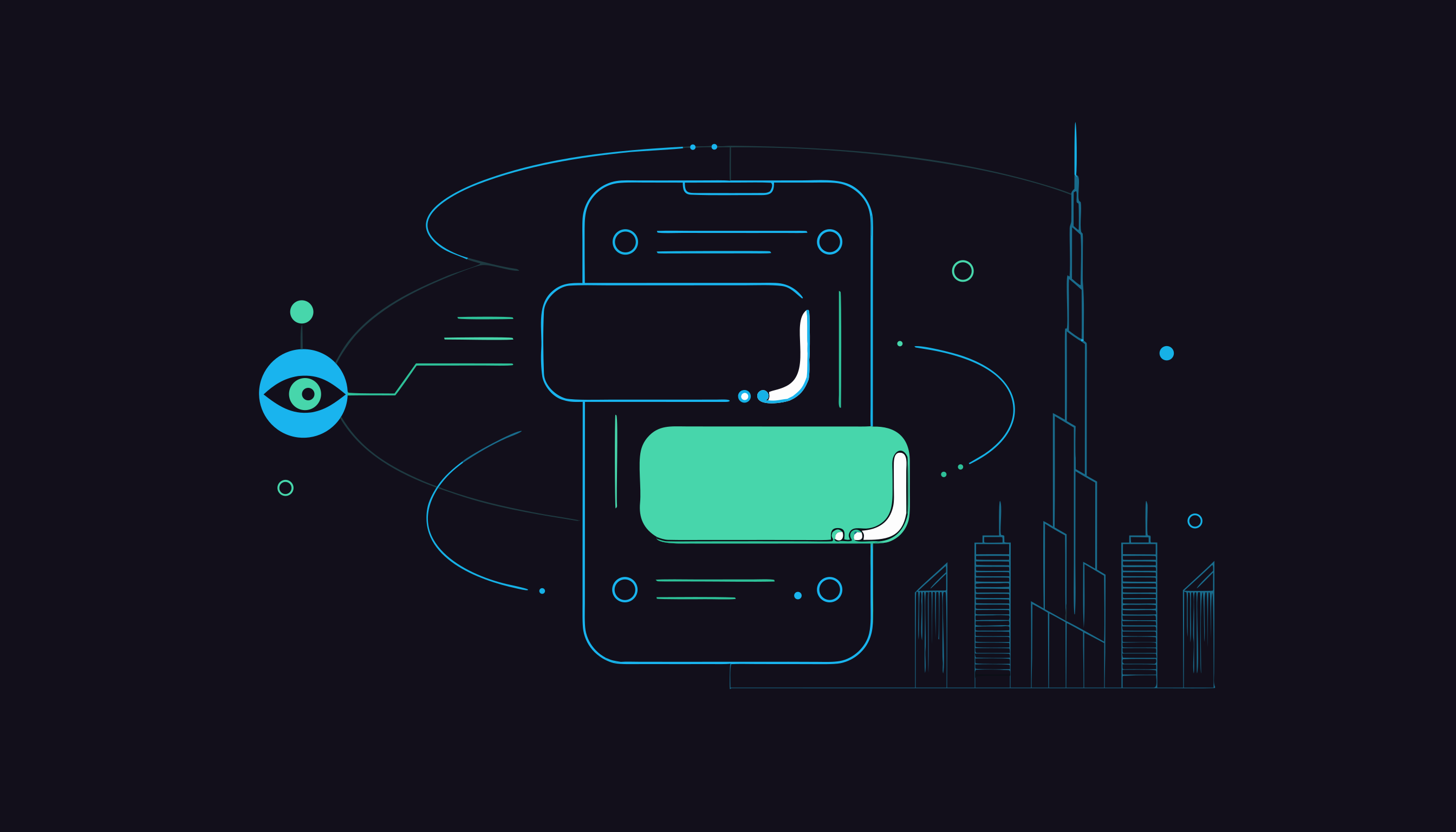
Business owners here ask me for the same thing: a WhatsApp chatbot Dubai customers will actually use — and most of them have already been sold one that nobody messages twice. The channel is right — WhatsApp is where customers here actually read their messages — but the execution usually isn't. This post covers what a WhatsApp chatbot for a Dubai business should do, what the platform rules actually are, and how to build one people use more than once.
Why WhatsApp Is the Channel That Gets Read Here
Email open rates in the UAE are not competitive with a message that lands next to your customer's personal chats. WhatsApp is the default messaging surface across Dubai's resident population, and unlike a mobile app, it requires no install and no onboarding — the customer is already in it.
That reach comes with constraints. WhatsApp is strict about when you may message people: outbound messages are allowed inside a 24-hour window after the customer's last message, and outside that window you can only send from a pre-approved template. Marketing templates go through Meta's approval process, and anything that reads like spam gets rejected or, worse, gets your number's quality rating dropped. A chatbot designed without those rules in mind becomes unsendable the moment you need it most.
The practical implication: a good WhatsApp chatbot is built around inbound intent. The customer messages you, you respond inside the session, and you earn the right to follow up by being useful first.
What a Chatbot Can Realistically Do for a Dubai Business
Based on what I've seen work, these are the high-value use cases:
- Lead qualification. Ask three or four questions — unit type, budget range, move-in timeline — then hand a scored lead to sales with the full transcript attached.
- Booking and scheduling. Property viewings, salon appointments, restaurant reservations, table or tour slots, with confirmation and reminder messages.
- Instant answers to the top twenty questions. Pricing, locations, working hours, payment plans, delivery times. Deflecting these is where the hours get saved.
- Document and status requests. "Send me my booking status" or "share the brochure," answered by a system call rather than a person.
- Post-sale support. Collecting details, attaching photos, and creating a ticket before a human ever joins the chat.
What it should not do is pretend to be a person indefinitely. Customers in Dubai are sophisticated about this, and the trust cost of a chatbot that dodges a direct question is higher than the cost of admitting a human is joining the conversation. Escalation is a feature, not an admission of failure.
One note for property businesses: the chatbot is only ever the front door. If the site behind it is weak, you're automating the loss of a lead rather than its capture — that's the side I covered in real estate website design in Dubai.
WhatsApp Business App vs. the Business Platform (API)
There are two paths, and choosing wrong is the most common expensive mistake.
| Business App | Business Platform (API) | |
|---|---|---|
| Cost | Free | Conversation-based pricing, billed by Meta |
| Setup | Self-serve, minutes | Business verification, number setup, often via a provider |
| Team access | Limited device/agent support | Multiple agents, shared inbox, routing |
| Automation | Basic auto-replies and labels | Full chatbot, webhooks, structured flows |
| Scale | Small operation | Anything with real volume |
If you're a two-person team answering a dozen messages a day, the app is enough — don't let anyone sell you an integration for that. The moment you need a bot answering common questions, more than one agent on the queue, or messages triggered from your CRM, you need the Business Platform. Verification takes real time (document checks with Meta, not your vendor), so plan for it rather than discovering it the week of launch.
For the build itself, the shape is consistent: Meta's webhook posts inbound messages to your backend, your backend calls the model or rules engine for a response, and you reply through the API within the session window. Everything interesting — the conversation logic, the CRM handoff, the escalation rules — lives in your backend, which is exactly where you want control.
Arabic, English, and Getting the Tone Right
A Dubai chatbot that only handles English will frustrate a meaningful share of your customers, and one that only handles Arabic will frustrate the rest. In practice I build bilingual flows with an explicit language choice in the first message, then keep the rest of the conversation in that language.
Two things that consistently go wrong:
- Mixed-script parsing. Customers switch languages mid-sentence. Make sure your intent detection and any extraction logic handle that, and test with real mixed messages rather than clean examples.
- Transliteration. People write Arabic in Latin characters and vice versa ("yalla", "shukran", brand names spelled three ways). Normalize before matching.
Tone should match the business. A real estate launch and a neighborhood clinic should not sound like the same bot. Write the greeting, the escalation line, and the closing in your own words — template-sounding copy is the fastest way to train customers to ignore you.
Flows That Actually Convert
The flows that work share a structure: confirm intent, collect only what's needed, deliver value, then ask for the next step.
- Greet with a menu, not a paragraph. Two or three tappable options tell the customer immediately what the bot can do.
- Collect incrementally. Ask one question at a time. A six-field form in a chat window gets abandoned; three questions spread across the conversation gets completed.
- Deliver before you ask. Give the price, the brochure, or the availability before requesting a phone number. Reciprocity works in messaging too.
- Make handoff obvious. A persistent "talk to a person" option, routed to a human with the transcript already visible.
- Follow up with templates, sparingly. One useful follow-up after a viewing or a quote is service; three in a week is why people block you.
Something I built for exactly this entry point: MiniURLX creates custom WhatsApp links with a pre-filled message, plus branded short URLs and QR codes with click tracking. Starting a conversation from a billboard, a brochure, or a listing with the customer's intent already in the first message dramatically improves what your bot can do with message one — you're no longer spending the opening exchange on "hi" and "hello, how can I help."
Measuring Whether It Works
Track the numbers that reflect real conversations, not vanity metrics:
- Containment rate — conversations resolved without a human. Useful, but only if customers aren't abandoning instead.
- Escalation volume and reasons — the reasons are a backlog of bot improvements, ranked for free.
- Drop-off point — where in the flow people go quiet. That's your broken question.
- Response time to human handoff — the number customers actually judge you on.
Review transcripts weekly for the first month. No dashboard replaces reading fifty real conversations, and that review is where you'll find the phrasing your customers use versus the phrasing you assumed.
FAQ
How much does a WhatsApp chatbot cost to build in Dubai?
It depends on two variables: whether you use the free Business App or the paid Business Platform (billed by Meta per conversation), and how much custom logic sits behind it. A menu-driven bot answering FAQs is small; one integrated with your CRM, booking system, and handoff routing is a proper project.
Do I need Meta verification to start?
For the Business App, no — you can start today. For the Business Platform, yes: business verification and number setup are required before you can message customers at scale, and the document review is the part most likely to slow your timeline.
Can the chatbot speak Arabic as well as English?
Yes, and it should. Build both languages with an explicit choice at the start, handle customers mixing the two in one message, and test with transliterated text. Plan the content for both languages from day one rather than translating as an afterthought.
Will customers accept talking to a bot?
They will, if it answers quickly and gets out of the way — and if a human is one message away. The failures I see are bots that hide the escalation option, answer vaguely, or loop. Clear scope, honest disclosure, and fast handoff keep trust intact.
Start by writing down the ten questions your team answers every week and the three actions customers ask for most — that's your first release, and nothing beyond it. If you want a chatbot that survives its first month with real customers, get in touch and we can scope it properly. You can also see my other Dubai and UAE builds in my portfolio.